How to Keep a Jellyfish
Yes. Jellyfish can easily be kept in captivity these days because of massive advances in technology. At one point, we had no clue on how to keep jellyfish. We were confused why they didn’t thrive in a normal box aquarium. We were confused that they didn’t eat normal food. There was a lot to learn, but now, after years of research, we know better. We learned that jellyfish tanks need a particular flow, and a particular shape of tank. We learned that jellyfish have small mouths and can only eat a specific size of food. We learned how to control temperature in an aquarium, and we learned how to filter the water easily.
These days, keeping jellyfish is easier than ever. You might be used to seeing fisheries in China raise the flame jellyfish, or see the Monterey Bay aquarium keep massive sea nettles. But what you may have just learned is that you too can keep jellyfish!
Is it Easy to Keep Jellyfish?
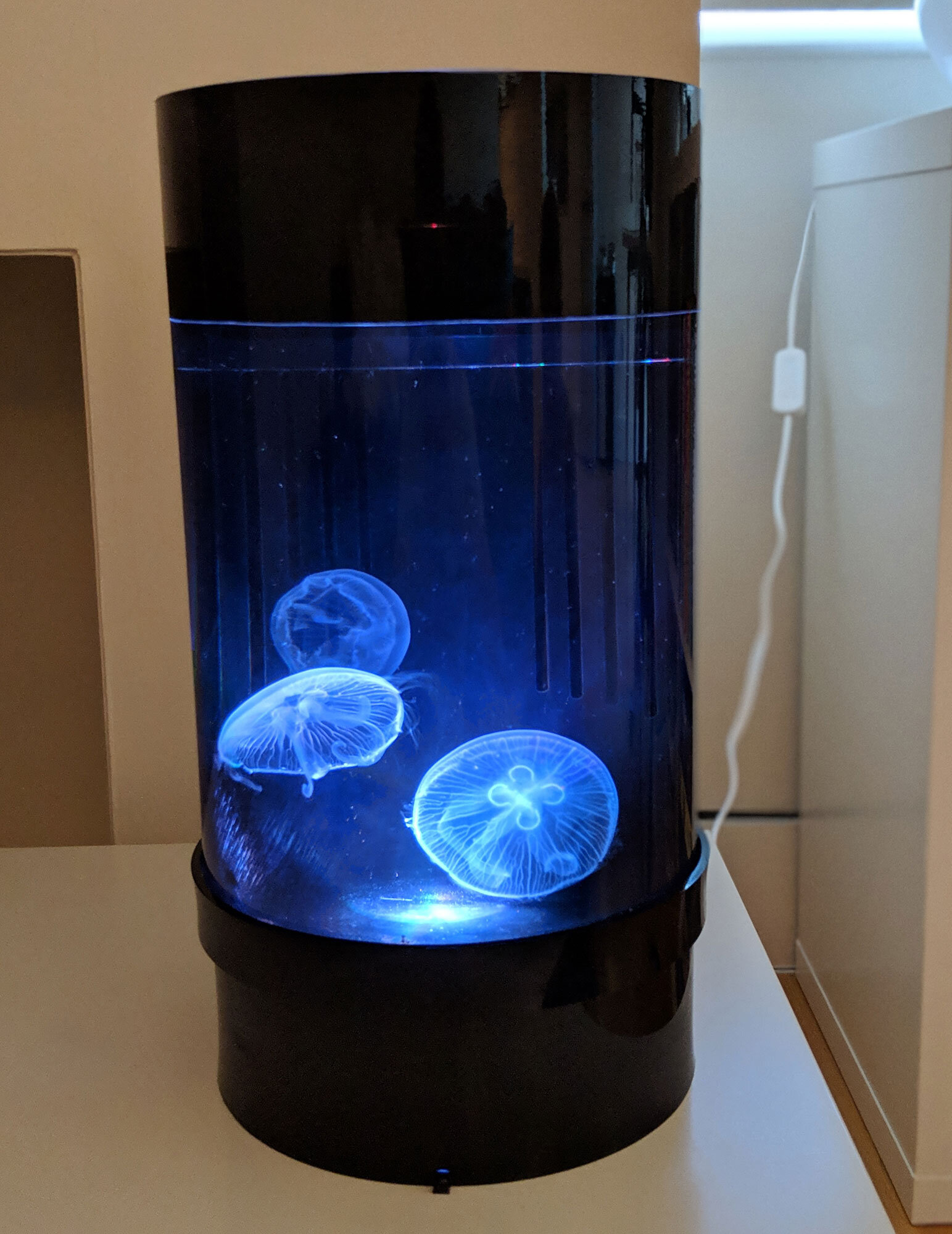
Nowadays, yes. You no longer need to build your own aquarium, you can simply purchase one from us! We offer multiple varieties of tank designs, ranging from our smallest tank being only 2 liters of water to our largest being 10 gallons.
These days, feeding jellyfish is also easier than ever. You have the options of dry food, live food, and even frozen food to care for your jellyfish. No longer do you have to have massive complex machines from out of a science fiction movie!
So in that respect, keeping jellyfish is easy. In fact, I would argue that keeping jellyfish is easier than keeping your average saltwater tank. It’s more difficult than freshwater, certainly, because you have to pre-mix aquarium salt into RODI (reverse osmosis deionized) water. That mixing process is possibly the most difficult aspect. We will cover how to mix water in our section devoted to water, so you’ll learn fairly quickly that mixing up a batch of saltwater isn’t difficult at all!
The other difficulty in keeping jellyfish is ensuring that the water they live in is clean. You want to avoid spikes in water chemistry, and you want to keep the water fairly stable. This means that on a regular basis, at least once a week, you want to change some of the old saltwater in your aquarium with fresh saltwater, to keep the tank from getting too mucky.
So think of it this way. A jellyfish may be harder than a goldfish, but it’s actually very easy if you compare it to keeping your average fish tank. You just have to make sure that the temperature of the aquarium is stable, that the salinity in the water doesn’t spike suddenly, and that you clean your aquarium on a regular basis. If you master these three cornerstones of jellyfish keeping, you’ll soon be an expert just like us here at Jellyfish Aquarium!
Of course, it may sound like I’m tossing gibberish at you right now. But by the end of this article, you should feel confident and ready to tackle even the most intimidating jellyfish out there! Mind you, seeing as they’re body composition is over 95% water, that might not be such a difficult task…
What Do I Need to Know?
Jellyfish keeping can be broken down into three easy parts. Keep the water clean and stable, feed them good food, and clean the tank once a week. If you do these three tasks, your jellyfish will live a happy life. Of course, this may not mean much without understanding what each part means. That’s why I set out to write this blog, to teach you how to take care of your jellyfish to the very best of your abilities.
The first task we will tackle is water. Then, once you’ve learned about water chemistry (which sounds far more intimidating than it is) and salinity levels, we can focus on feeding your jellyfish. After you’ve learned the two most crucial aspects of jellyfish care, you can learn about how to clean a jellyfish tank. This is far easier than you’re probably expecting. If you master water, food and cleaning, you’ll realize keeping jellyfish is surprisingly easy!
Water

Jellyfish bodies are composed of over 95% water. What does this mean though? For us, it means that to keep the jellyfish healthy, we have to keep the water they live in ‘healthy’.
The first step to keeping our water healthy and clean is to use the right type of water. With most fish, you don’t have to worry about the minerals in the water, and you can simply use a dechlorinator from your local pet shop to keep your fish healthy. With jellyfish, they take it a step further. Jellyfish are very sensitive to trace minerals in tap and well water. So thus, jellyfish need a special type of water known as RODI (reverse osmosis deionized) water. You can simply use RO (reverse osmosis) water, but RODI water is what’s preferred. Be careful though, as simply picking up water from the store can be a bit tricky! Sometimes, they slip minerals into the water, so be sure to read the label of the bottle that you’re using. Consider it calorie tracking for your jellyfish! But if you really want to be safe, just use RODI water from a water shop or, better yet, buy your own RODI machine and use it at home. They’re easy to set up, and will save you plenty of money in the long run.
Now, jellyfish don’t just live in RODI water. They live in saltwater. This means we have to mix salt into the RODI water before we can use it in our aquariums. Unless specified, all our jellyfish live at a salinity of 30 parts per thousand (ppt), or 1.0226 specific gravity (sg). You can use a refractometer, hydrometer, or my preference a digital refractometer to read the salinity levels of the water.

Mix salt into your water as per the package instructions, and take readings with your chosen method of reading salinity, and make sure it reads 30ppt or 1.0266sg before using it in your aquarium. You’ll want to mix the salt into the water at least the night before a water change, and stir it up. This is to ensure the salt is thoroughly dissolved in the water before you put it in your jellyfish tank. We noticed that if the salt isn’t full dissolved, the salt can stick to the jellyfish, and they can take on a wonky shape. This doesn’t mean your jellyfish is harmed, but they will look a bit odd.
Now you can’t just add in jellyfish after you mix up your water and your tank is filled. You need to cycle your tank first! To learn more about cycling a tank, take a look at our blog here!
Now, once your jellyfish are in the water, you need to make sure that there are no spikes in water chemistry. But what do we mean by water chemistry? By water chemistry, we mean three different byproducts of waste being broken down. I discuss it more in the water cycling blog, but essentially these three byproducts can be very harmful to your jellyfish. You need them to cycle the tank, but by the time it’s finished cycling and you have jellyfish, you shouldn’t be reading any ammonia or nitrite. When jellyfish are in the tank, these readings should be 0. If it’s anymore, change the water in your tank as soon as you can. Nitrates however is a different story. Though 0 nitrates is ideal, you can get away with nitrates climbing to 20. But beyond that, it will start to affect the jellyfish’s health for the worse. So thus, try to keep the water chemistry readings down, and your jellyfish will be very healthy!

But how do you read water chemistry? Well, there are some very complicated methods, but the easiest is to use the API 5in1 strip that we sell on our website, and dip it into the aquarium. When you pull it out of the water, it should give nearly instantaneous results. Though they may not be the most accurate, they are the easiest. And honestly, using an easy method and consistently testing is better than using a complicated method and avoiding testing the water at all.
And that’s it! Use RODI water mixed with aquarium salt. Then, cycle your tank before adding jellyfish, and you’ll never have to cycle it again! One a week, or once a day if you can, check the water chemistry in your tank and see how it looks. It sounds like a lot, but in truth it’s quite simple.
Food
The next cornerstone of jellyfish care is feeding. Specifically, what do you feed your jellyfish? The answer is, there’s a variety! The most common food we sell is Jellychow. Jellychow is essentially freeze dried zooplankton. We sell it with a small scoop, which you can use to measure out how much you feed your jellyfish. We encourage you to feed only half a spoonful once per day. This is because though the food is convenient, it can really dirty the water.

So if you want to avoid dirtying the water, what food should you provide? The best answer is live. We sell brine shrimp eggs that you can hatch, and use the freshly hatched brine shrimp to feed your jellyfish. We also have a blog on jellyfish, so be sure to check it out here!

But brine shrimp alone isn’t the best diet. So what do you do? At jellyfish Aquarium, we came up with an easy feeding schedule. Every day, we feed our jellyfish freshly hatched brine shrimp except on the day before a water change. On the day before a water change, we feed our jellyfish Jellychow. This allows our jellyfish to have a healthy, balanced diet, and we can keep the water clean easily!
By feeding a mixture of fresh and dry food, our jellyfish are very healthy and well looked after.
Cleaning
Cleaning a jellyfish tank is really quite simple. It’s very similar to cleaning a regular fish tank.

Siphon out the bottom of the tank into a bucket, and replace the amount of water you took out with fresh saltwater that you’ve mixed the night before. We recommend changing about 25% of the water once a week. Be careful when siphoning though, as you don’t want to accidentally suck up your jellyfish! To prevent this, grab the siphon hose, and form a sort of kink in the hose with your free hand. When the jellyfish gets close to the siphon, kink the hose to stop the siphon, and once they’re passed by, you can open the siphon again to continue cleaning. For our visual learners, Aquarium Co-Op has an excellent video.
Once you’ve finished siphoning, use a scrubbing pad to clean down the sides of the tank. Then, when you’re finished cleaning the inside, use the acrylic cleaning cloth or a soft towel to mop up any water that’s gotten out of the tank.
Once a month, though, it’s advised to give a more thorough cleaning. This means scrubbing the inside of the airline tubing with a pipe cleaner, and cleaning the sponge in the back of the filter in dirty tank water. It may seem odd rinsing the sponge in the dirty tank water, but it’s because you don’t want to lose any of the beneficial bacteria that’s built up in the aquarium. So simply take out the sponge and rinse it in the dirty tank water, and put it back in the tank. It’s as simple as that!
The whole process usually takes between half an hour to an hour, depending on how dirty the tank is and if you’re doing a thorough clean.
Kits and Packages

If you’re interested in getting a jellyfish but the amount of products is overwhelming, Jellyfish Aquarium has a couple of options to help you out.
The kit I recommend to anyone buying jellyfish is the quarterly supply kit. The quarterly supply kit includes all the necessary products you would need to keep your jellyfish healthy. The kit includes aquarium salt, jellychow, pristine and chemipure blue nano.
Aquarium salt and jellychow are fairly self explanatory, but I haven’t covered Pristine or Chemipure yet. Seachem Pristine is a fantastic product that can be added the first few days after adding jellyfish to the tank. It provides bacteria to the water that will help prevent a spike in water chemistry, and it seems to benefit the jellyfish in the long run.
Chemipure is a carbon packet that aids in the filtration process. You place it in the filter compartment of your tank, submerged in water. It helps prevent a build of poor water chemistry.
The quarterly supply kit comes in two options, with and without test strips. We do recommend the package with test strips as it gives you the option to check your water quality more frequently. This is especially important in the first few months of keeping jellyfish.
The quarterly supply kit typically lasts for at least 4 months before the supplies run out, and it’s advised to buy from us again.
The other kit that Jellyfish Aquarium encourages you purchase with your tank is the pro maintenance kit. The pro maintenance kit includes all the supplies you need to clean your tank, such as the siphon, the jellything tool, the acrylic cleaning cloth and the algae scrub pad.
All of these pieces of equipment are excellent to use when cleaning your tank.
Takeaway
So there you have it! Those are the three important steps to keeping jellyfish. Mix up RODI water and aquarium salt, feed your jellyfish healthy food, and clean the tank once a week. If you master these three aspects of jellyfish keeping, your jellyfish will be healthy and live a (relatively) long life!